

Latest Dec-2025 FCSS_EFW_AD-7.6 Dumps PDF And Certification Training
Check your preparation for Fortinet FCSS_EFW_AD-7.6 On-Demand Exam
NEW QUESTION # 16
Refer to the exhibit, which shows the ADVPN IPsec interface representing the VPN IPsec phase 1 from Hub A to Spoke 1 and Spoke 2, and from Hub # to Spoke 3 and Spoke 4.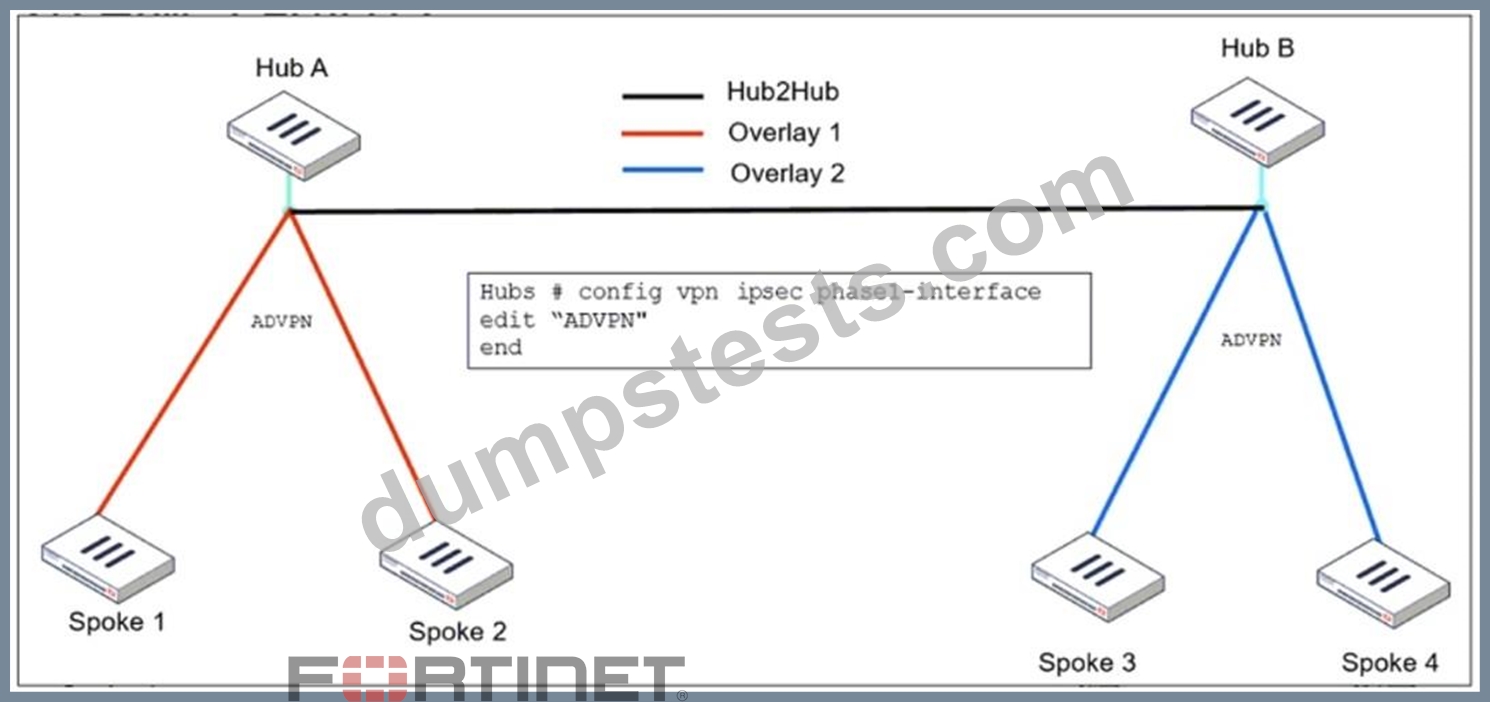
An administrator must configure an ADVPN using IBGP and EBGP to connect overlay network 1 with 2.
What must the administrator configure in the phase 1 VPN IPsec configuration of the ADVPN tunnels?
- A. set auto-discovery-crossover enable and set enforce-multihop enable
- B. set auto-discovery-sender enable and set network-id x
- C. set auto-discovery-forwarder enable and set remote-as x
- D. set auto-discovery-receiver enable and set npu-offload enable
Answer: A
Explanation:
When configuring ADVPN (Auto-Discovery VPN) to connect overlay networks across different hubs using IBGP and EBGP, special configurations are required to allow spokes from different overlay networks to dynamically establish tunnels.
# set auto-discovery-crossover enable
# This allows cross-hub tunnel discovery in an ADVPN deployment where multiple hubs are used.
# Since Hub A and Hub B belong to different overlays, enabling crossover discovery ensures that spokes from one overlay can dynamically create direct tunnels to spokes in the other overlay when needed.
# set enforce-multihop enable
# This setting ensures that BGP peers using loopback interfaces can establish connectivity even if they are not directly connected.
# Multihop BGP sessions are required when using loopback addresses as BGP peer sources because the connection might need to traverse multiple routers before reaching the BGP neighbor.
# This is especially useful in ADVPN deployments with multiple hubs, where routes might need to cross from one hub to another.
NEW QUESTION # 17
Refer to the exhibit, which shows a revision history window in the FortiManager device layer.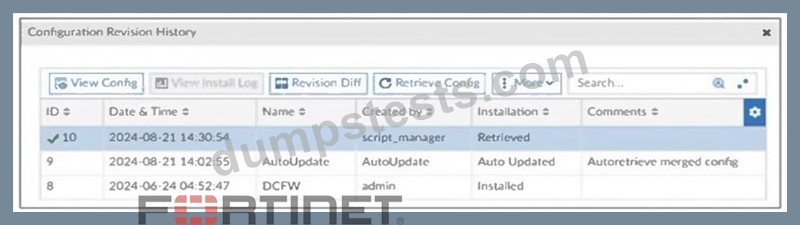
The IT team is trying to identify the administrator responsible for the most recent update in the FortiGate device database.
Which conclusion can you draw about this scenario?
- A. This retrieved process was automatically triggered by a Remote FortiGate Directly (via CLI) script.
- B. Find the user in the FortiManager system logs and use the type=script command to find the administrator user in the user field.
- C. The user script_manager is an API user from the Fortinet Developer Network (FDN) retrieving a configuration.
- D. To identify the user who created the event, check it on the Configuration and Installation widget on FortiGate within the FortiManager device layer.
Answer: B
Explanation:
The Configuration Revision History window in FortiManager shows that the most recent configuration change (ID 10) was created by script_manager with the action Retrieved.
Since script_manager is a system-level script execution user, the IT team needs to find who actually triggered this script. This can be done by:
# Checking the FortiManager system logs for script execution events.
# Using the type=script filter to locate the administrator associated with the script execution.
NEW QUESTION # 18
Refer to the exhibit, which shows a partial enterprise network.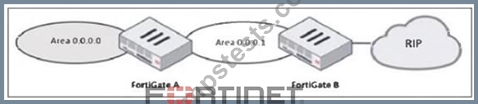
An administrator would like the area 0.0.0.0 to detect the external network.
What must the administrator configure?
- A. Configure a distribute-route-map-in on FortiGate B.
- B. Set the area 0.0.0.l type to stub on FortiGate A and B.
- C. Configure a virtual link between FortiGate A and B.
- D. Enable RIP redistribution on FortiGate B.
Answer: D
Explanation:
The diagram shows a multi-area OSPF network where:
# FortiGate A is in OSPF Area 0 (Backbone area).
# FortiGate B is in OSPF Area 0.0.0.1 and is connected to an RIP network.
To ensure that OSPF Area 0 (0.0.0.0) learns routes from the external RIP network, FortiGate B must redistribute RIP routes into OSPF.
Steps to achieve this:
1. Enable route redistribution on FortiGate B to inject RIP-learned routes into OSPF.
2. This allows OSPF Area 0.0.0.1 to forward RIP routes to OSPF Area 0 (0.0.0.0), making the external network visible.
NEW QUESTION # 19
Refer to the exhibit, which shows an enterprise network connected to an internet service provider.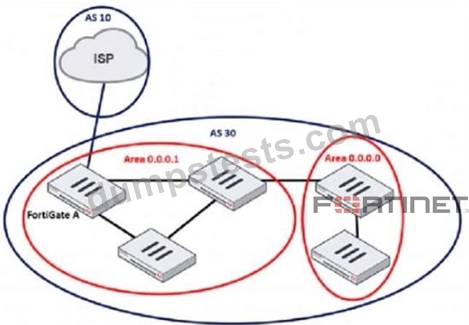
The administrator must configure the BGP section of FortiGate A to give internet access to the enterprise network.
Which command must the administrator use to establish a connection with the internet service provider?
- A. config neighbor
- B. config redistribute bgp
- C. config redistribute ospf
- D. config router route-map
Answer: A
Explanation:
In BGP (Border Gateway Protocol), a neighbor (peer) configuration is required to establish a connection between two BGP routers. Since FortiGate A is connecting to the ISP (Autonomous System 10) from AS
30, the administrator must define the ISP's BGP router as a neighbor.
The config neighbor command is used to:
# Define the ISP's IP address as a BGP peer
# Specify the remote AS (AS 10 in this case)
# Allow BGP route exchanges between FortiGate A and the ISP
NEW QUESTION # 20
Refer to the exhibit, which contains a partial command output.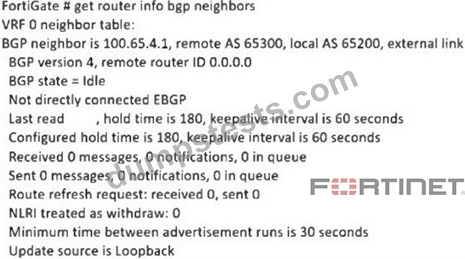
The administrator has configured BGP on FortiGate. The status of this new BGP configuration is shown in the exhibit.
What configuration must the administrator consider next?
- A. Contact the remote peer administrator to enable BGP
- B. Configure the local AS to 65300.
- C. Configure a static route to 100.65.4.1.
- D. Enable ebgp-enforce-multihop.
Answer: D
Explanation:
From the BGP neighbor status output, the key issue is that BGP is stuck in the "Idle" state, meaning the FortiGate is unable to establish a BGP session with its peer 100.65.4.1 (Remote AS 65300).
The output also shows:
# "Not directly connected EBGP" # This means the BGP peer is not on the same subnet, requiring multihop BGP.
# "Update source is Loopback" # Since a loopback interface is used, FortiGate must be configured to allow BGP neighbors over multiple hops.
To resolve this issue, the administrator must enable ebgp-enforce-multihop, which allows BGP sessions to be established even when the neighbors are not directly connected.
NEW QUESTION # 21
An administrator must enable direct communication between multiple spokes in a company's network. Each spoke has more than one internet connection.
The requirement is for the spokes to connect directly without passing through the hub, and for the links to automatically switch to the best available connection.
How can this automatic detection and optimal link utilization between spokes be achieved?
- A. Establish static VPN tunnels between spokes with predefined backup routes.
- B. Implement SD-WAN policies at the hub to manage spoke link quality.
- C. Set up OSPF routing over static VPN tunnels between spokes.
- D. Utilize ADVPN 2.0 to facilitate dynamic direct tunnels and automatic link optimization.
Answer: D
Explanation:
ADVPN (Auto-Discovery VPN) 2.0 is the optimal solution for enabling direct spoke-to-spoke communication without passing through the hub, while also allowing automatic link selection based on quality metrics.
# Dynamic Direct Tunnels:
# ADVPN 2.0 allows spokes to establish direct IPsec tunnels dynamically based on traffic patterns, reducing latency and improving performance.
# Unlike static VPNs, spokes do not need to pre-configure tunnels for each other.
# Automatic Link Optimization:
# ADVPN 2.0 monitors the quality of multiple internet connections on each spoke.
# It automatically switches to the best available connection when the primary link degrades or fails.
# This is achieved by dynamically adjusting BGP-based routing or leveraging SD-WAN integration.
NEW QUESTION # 22
Refer to the exhibit.
A pre-run CLI template that is used in zero-touch provisioning (ZTP) and low-touch provisioning (LTP) with FortiManager is shown.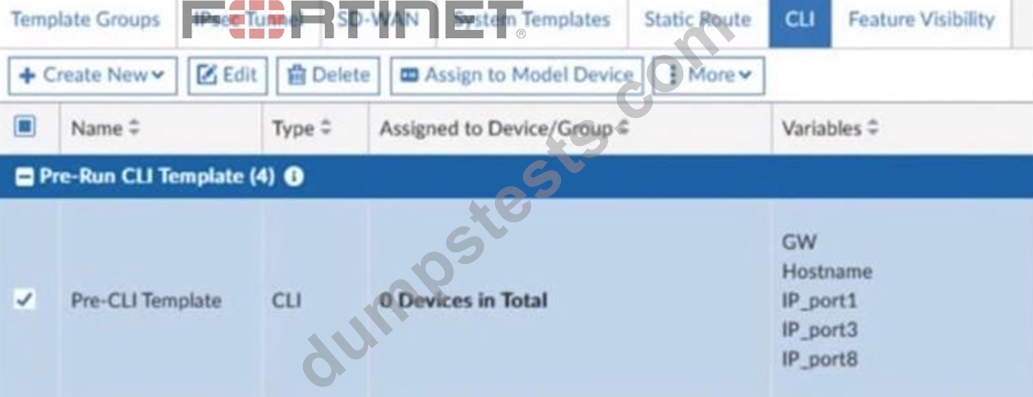
The template is not assigned even though the configuration has already been installed on FortiGate.
What is true about this scenario?
- A. Pre-run CLI templates are automatically unassigned after their initial installation
- B. The administrator did not assign the template correctly when adding the model device because pre-CLI templates remain permanently assigned to the firewall
- C. The administrator must use post-run CLI templates that are designed for ZTP and LTP
- D. Pre-run CLI templates for ZTP and LTP must be unassigned manually after the first installation to avoid conflicting error objects when importing a policy package
Answer: A
Explanation:
In FortiManager, pre-run CLI templates are used in Zero-Touch Provisioning (ZTP) and Low-Touch Provisioning (LTP) to configure a FortiGate device before it is fully managed by FortiManager.
These templates apply configurations when a device is initially provisioned. Once the pre-run CLI template is executed, FortiManager automatically unassigns it from the device because it is not meant to persist like other policy configurations. This prevents conflicts and ensures that the FortiGate configuration is not repeatedly applied after the initial setup.
NEW QUESTION # 23
Refer to the exhibit, which contains the partial output of an OSPF command.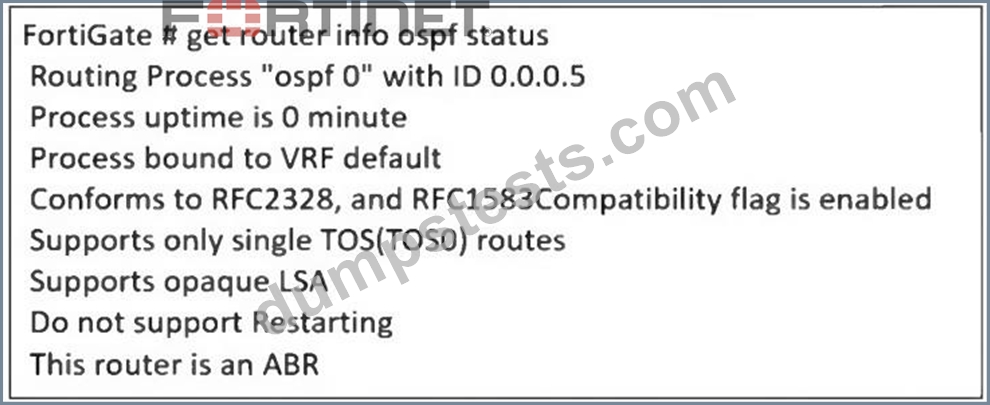
An administrator is checking the OSPF status of a FortiGate device and receives the output shown in the exhibit.
What two conclusions can the administrator draw? (Choose two.)
- A. The FortiGate device is a backup designated router
- B. The FortiGate device is connected to multiple areas
- C. The FortiGate device injects external routing information
- D. The FortiGate device has OSPF ECMP enabled
Answer: B,C
Explanation:
The output of the get router info ospf status command provides key information about the OSPF (Open Shortest Path First) configuration on the FortiGate device.
The FortiGate device is connected to multiple areas
# The output states: "This router is an ABR"
# ABR (Area Border Router) means the device is connected to multiple OSPF areas and maintains routing information between them.
# This confirms that the FortiGate is not just in one area, but at least one backbone area (Area 0) and another OSPF area.
The FortiGate device injects external routing information
# The output states: "Supports opaque LSA"
# Opaque LSAs (Type 9, 10, and 11) are used in OSPF extensions, including those that support external route injection.
# Typically, ABRs or ASBRs (Autonomous System Boundary Routers) inject external routes, allowing routes from other routing protocols (such as BGP or static routes) to be advertised into OSPF.
NEW QUESTION # 24
Refer to the exhibit, which shows the FortiGuard Distribution Network of a FortiGate device.
FortiGuard Distribution Network on FortiGate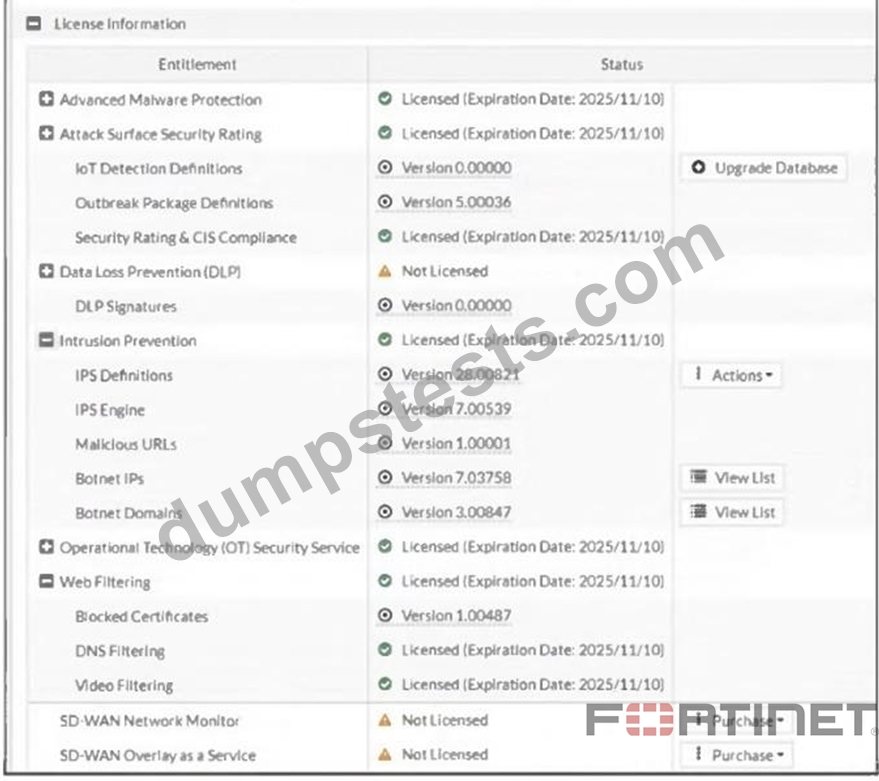
An administrator is trying to find the web filter database signature on FortiGate to resolve issues with websites not being filtered correctly in a flow-mode web filter profile.
Why is the web filter database version not visible on the GUI, such as with IPS definitions?
- A. The web filter database is only accessible after manual syncing with a valid FDS server using diagnose test update info.
- B. The web filter database is not hosted on FortiGate: FortiGate queries FortiGuard or FortiManager for web filter ratings on demand.
- C. The web filter database is stored locally, but the administrator must run over CLI diagnose autoupdate versions.
- D. The web filter database is stored locally on FortiGate, but it is hidden behind the GUI. It requires enabling debug mode to make it visible.
Answer: B
Explanation:
Unlike IPS or antivirus databases, FortiGate does not store a full web filter database locally. Instead, FortiGate queries FortiGuard (or FortiManager, if configured) dynamically to classify and filter web content in real time.
Key points:
# Web filtering works on a cloud-based model:
# When a user requests a website, FortiGate queries FortiGuard servers to check its category and reputation.
# The response is then cached locally for faster lookups on repeated requests.
# No local web filter database version:
# Unlike IPS and antivirus, which download and store signature updates locally, web filtering relies on cloud-based queries.
# This is why no database version appears in the GUI.
# Flow mode vs Proxy mode:
# In proxy mode, FortiGate can cache some web filter data, improving performance.
# In flow mode, all queries happen dynamically, with no locally stored database.
NEW QUESTION # 25
An administrator needs to install an IPS profile without triggering false positives that can impact applications and cause problems with the user's normal traffic flow.
Which action can the administrator take to prevent false positives on IPS analysis?
- A. Enable Scan Outgoing Connections to avoid clicking suspicious links or attachments that can deliver botnet malware and create false positives.
- B. Use the IPS profile extension to select an operating system, protocol, and application for all the network internal services and users to prevent false positives.
- C. Install missing or expired SSUTLS certificates on the client PC to prevent expected false positives.
- D. Use an IPS profile with action monitor, however, the administrator must be aware that this can compromise network integrity.
Answer: B
Explanation:
False positives in Intrusion Prevention System (IPS) analysis can disrupt legitimate traffic and negatively impact user experience. To reduce false positives while maintaining security, administrators can:
# Use IPS profile extensions to fine-tune the settings based on the organization's environment.
# Select the correct operating system, protocol, and application types to ensure that IPS signatures match the network's actual traffic patterns, reducing false positives.
# Customize signature selection based on the network's specific services, filtering out unnecessary or irrelevant signatures.
NEW QUESTION # 26
Refer to the exhibit, which shows a physical topology and a traffic log.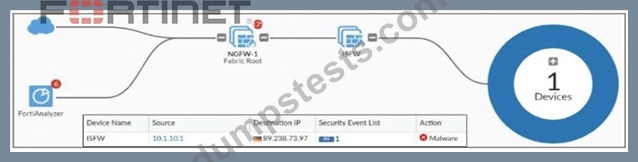
The administrator is checking on FortiAnalyzer traffic from the device with IP address 10.1.10.1, located behind the FortiGate ISFW device.
The firewall policy in on the ISFW device does not have UTM enabled and the administrator is surprised to see a log with the action Malware, as shown in the exhibit.
What are the two reasons FortiAnalyzer would display this log? (Choose two.)
- A. Security rating is enabled in ISFW.
- B. The firewall policy in NGFW-1 has UTM enabled.
- C. ISFW is in a Security Fabric environment.
- D. ISFW is not connected to FortiAnalyzer and must go through NGFW-1.
Answer: B,C
Explanation:
From the exhibit, ISFW is part of a Security Fabric environment with NGFW-1 as the Fabric Root. In this architecture, FortiGate devices share security intelligence, including logs and detected threats.
ISFW is in a Security Fabric environment:
# Security Fabric allows devices like ISFW to receive threat intelligence from NGFW-1, even if UTM is not enabled locally.
# If NGFW-1 detects malware from IP 10.1.10.1 to 89.238.73.97, this information can be propagated to ISFW and FortiAnalyzer.
The firewall policy in NGFW-1 has UTM enabled:
# Even though ISFW does not have UTM enabled, NGFW-1 (which sits between ISFW and the external network) does have UTM enabled and is scanning traffic.
# Since NGFW-1 detects malware in the session, it logs the event, which is then sent to FortiAnalyzer.
NEW QUESTION # 27
An administrator configured the FortiGate devices in an enterprise network to join the Fortinet Security Fabric. The administrator has a list of IP addresses that must be blocked by the data center firewall. This list is updated daily.
How can the administrator automate a firewall policy with the daily updated list?
- A. With an external connector from Threat Feeds
- B. With FortiAnalyzer
- C. With FortiNAC
- D. With a Security Fabric automation
Answer: A
Explanation:
The best way to automate a firewall policy using a daily updated list of IP addresses is by using an external connector from Threat Feeds. This allows FortiGate to dynamically retrieve real-time threat intelligence from external sources and apply it directly to security policies.
By configuring Threat Feeds, the administrator can:
# Automatically update firewall policies with the latest malicious IPs daily.
# Block traffic from those IPs in real-time without manual intervention.
# Integrate with FortiGuard, third-party threat intelligence sources, or custom feeds (CSV, STIX
/TAXII, etc.).
NEW QUESTION # 28
Which two statements about IKEv2 are true if an administrator decides to implement IKEv2 in the VPN topology? (Choose two.)
- A. It exchanges a minimum of two messages to establish a secure tunnel.
- B. It supports interoperability with devices using IKEv1.
- C. It supports the extensible authentication protocol (EAP).
- D. It includes stronger Diffie-Hellman (DH) groups, such as Elliptic Curve (ECP) groups.
Answer: C,D
Explanation:
IKEv2 (Internet Key Exchange version 2) is an improvement over IKEv1, offering enhanced security, efficiency, and flexibility in VPN configurations.
It includes stronger Diffie-Hellman (DH) groups, such as Elliptic Curve (ECP) groups.
IKEv2 supports stronger cryptographic algorithms, including Elliptic Curve Diffie-Hellman (ECDH) groups such as ECP256 and ECP384, providing improved security compared to IKEv1.
It supports the extensible authentication protocol (EAP).
IKEv2 natively supports EAP authentication, which allows integration with external authentication mechanisms such as RADIUS, certificates, and smart cards. This is particularly useful for remote access VPNs where user authentication must be flexible and secure.
NEW QUESTION # 29
Why does the ISDB block layers 3 and 4 of the OSI model when applying content filtering? (Choose two.)
- A. FortiGate has a predefined list of all IPs and ports for specific applications downloaded from FortiGuard.
- B. The ISDB limits access by URL and domain.
- C. The ISDB works in proxy mode, allowing the analysis of packets in layers 3 and 4 of the OSI model.
- D. The ISDB blocks the IP addresses and ports of an application predefined by FortiGuard.
Answer: A,D
Explanation:
The Internet Service Database (ISDB) in FortiGate is used to enforce content filtering at Layer 3 (Network Layer) and Layer 4 (Transport Layer) of the OSI model by identifying applications based on their predefined IP addresses and ports.
FortiGate has a predefined list of all IPs and ports for specific applications downloaded from FortiGuard:
# FortiGate retrieves and updates a predefined list of IPs and ports for different internet services from FortiGuard.
# This allows FortiGate to block specific services at Layer 3 and Layer 4 without requiring deep packet inspection.
The ISDB blocks the IP addresses and ports of an application predefined by FortiGuard:
# ISDB works by matching traffic to known IP addresses and ports of categorized services.
# When an application or service is blocked, FortiGate prevents communication by denying traffic based on its destination IP and port number.
NEW QUESTION # 30
Refer to the exhibit, which shows a network diagram.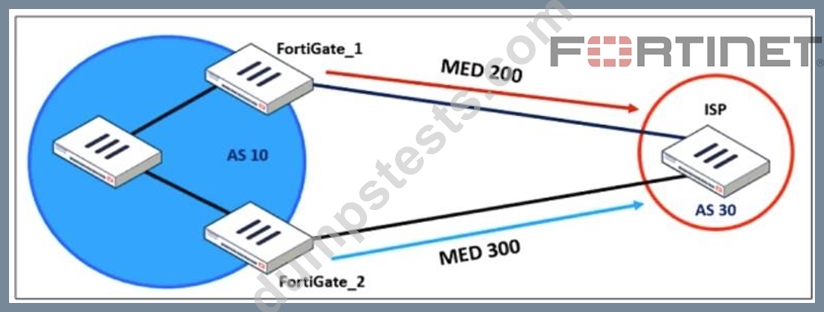
An administrator would like to modify the MED value advertised from FortiGate_1 to a BGP neighbor in the autonomous system 30.
What must the administrator configure on FortiGate_1 to implement this?
- A. distribute-list-out
- B. route-map-out
- C. network-import-check
- D. prefix-list-out
Answer: B
Explanation:
The Multi-Exit Discriminator (MED) is a BGP attribute used to influence the preferred path for incoming traffic from an external autonomous system (AS). The diagram shows that FortiGate_1 advertises MED 200, while FortiGate_2 advertises MED 300, meaning the ISP will prefer the route through FortiGate_1 because a lower MED is preferred in BGP.
To modify the MED value on FortiGate_1 for routes advertised to AS 30, the administrator must configure a route-map-out. A route map can match specific routes and set the MED value before sending them to the BGP neighbor.
NEW QUESTION # 31
......
Valid FCSS_EFW_AD-7.6 Dumps for Helping Passing Fortinet Exam: https://freetorrent.dumpstests.com/FCSS_EFW_AD-7.6-latest-test-dumps.html